Intro to the Class

Before walking through my project, here is a brief overview of the class, the design process it follows, and the teachers who oversaw this work.

What Is Pre-Engineering?

Pre-Engineering at SLA Middle School is a project-based class in which students work through real engineering challenges from start to finish — defining a problem, researching solutions, designing, building, and refining a working prototype. It mirrors the way professional engineers and designers approach problems in the field.

The Engineering Design Process

Every project follows a structured six-step cycle: Ask · Imagine · Plan · Develop · Test · Improve. Each phase is a distinct body of work with its own deliverables. My presentation is organized around these six steps so you can follow the progression of my thinking.

Who Oversaw This Project

This project was guided by Mr. Franklin, the lead Pre-Engineering teacher, and Ms. Graefeld, the student teacher present throughout the full duration of the project. Both were involved in setting the design challenge, guiding the process, and assessing the final work.

7th Grade · Pre-Engineering · SLA Middle School

Pre-Engineering
Outdoor Design

I redesigned the SLA-MS schoolyard to create a durable, socially-considered outdoor dining space capable of seating up to 700 students — developed over six weeks through research, sketching, scale modeling, and iterative revision.

Final Grade: 95 / 100  ·  Exceeds Expectations
Leo Sutter·Mr. Franklin & Ms. Graefeld·SLA Middle School · 2025–26
scroll or swipe

What Was I Asked to Do?

The first step of any engineering project is to fully understand the problem before developing any solution. Below is the challenge as set by Mr. Franklin and Ms. Graefeld, along with the additional requirements I set for myself.

Why This Project Exists

During COVID-19, outdoor dining expanded dramatically — New York City went from approximately 1,000 sidewalk restaurants to over 10,600 within a single year. SLA-MS faced a related opportunity: could the school's blacktop yard become a functional, well-designed outdoor social space for students?

Problem statement: Design a comfortable outdoor dining space for Science Leadership Academy Middle School that makes effective use of the schoolyard and accommodates a minimum of 45 students at a time.

What it had to include

Seating for at least 45 people — I set a personal goal of 700

Dedicated space to eat and space to sit

A designed solution — not simply tables and chairs placed on pavement

What it could not do

Consume more than 50% of the yard — recess space must be preserved

Consist only of standard tables and chairs

Self-added: Under $1.5M budget, 20+ year lifespan, socially-conscious layout

What I Studied Before Drawing Anything

Before developing any design concepts, I researched four sources on outdoor dining. This phase is where engineering decisions are grounded in real-world evidence rather than assumption.

01
NYC Sidewalk Café Guide

Official Regulations for Outdoor Seating

New York City's official guidelines for sidewalk restaurant seating — covering permits, layout standards, clearance requirements, and public space rules.

ADA accessibility requirements apply to all outdoor dining installations. NYC also prohibits advertising signage on outdoor café structures — a reminder that branding is regulated in public space.
02
Jardin Nelson — Old Montreal

Most Influential Source

A video documenting a historic open-air restaurant in Old Montreal, featuring custom funnel-shaped umbrellas with integrated drainage, strategic planting, and intentional lighting design.

This source fundamentally shaped my approach: density can feel intentional rather than crowded when the spatial design is considered. Social comfort is an engineerable quality.
03
Homes & Gardens

Practical Design Principles

Ten guidelines for outdoor dining spaces — covering weather-resistant material selection, visual consistency, and the transition between indoor and outdoor environments.

Material selection must account for full weather exposure. Stylistic consistency across a space is what makes a design feel unified rather than assembled from separate decisions.
04
Serwall Blog

A Lesson in Source Evaluation

An article titled "Outdoor dining ideas for a stylish outdoor restaurant," published on a furniture retailer's website.

Recognizing this as promotional content rather than independent guidance was itself a useful outcome — source credibility is a core part of the research phase in engineering.

Exploring Design Space with a Morph Chart

A morph chart is an engineering brainstorming tool that systematically maps all possible design combinations across a set of defined categories. With five categories and five options each, this chart generates 55 = 3,125 possible combinations.

Option A
Option B
Option C
Option D
Option E
Lighting
LED Strip
Open Flame
Spotlights
RGB Color
LED + RGB
Materials
Timber Slab
Cast Concrete
Gravel/Aggregate
All-Weather Mix
Free-Form Cast
Utilities
Power Only
Wi-Fi Only
Ethernet Ports
Wi-Fi + Power
Security Systems
Privacy
None
Planters Only
Custom Screens
Landscaping
Open + Planters
Aesthetic
Modern / Athletic
Rustic
Eclectic
Throwback
Modern Comfort
Highlighted cells in each row indicate the combination selected for the final design. Each choice was informed by research findings — the all-weather material mix came from outdoor durability principles in Source 3, and the open-plus-planters privacy approach was inspired by the social zoning observed at Jardin Nelson.

What I Designed

0
students
Maximum designed capacity
(450 at comfortable density)
0
%
Blacktop preserved for recess
(only 8% of yard used)
0
M USD
Estimated construction cost
(within the $1.5M budget goal)
0
zones
Distinct activity areas
with differentiated social functions

The design is engineered around how students actually use a shared yard — accounting for natural gathering patterns, social group dynamics, circulation flow, and potential conflict points. Shade sails and radiant heating towers extend usability across all four Philadelphia seasons, with shade angles optimized for peak hours between 10 a.m. and 2 p.m.
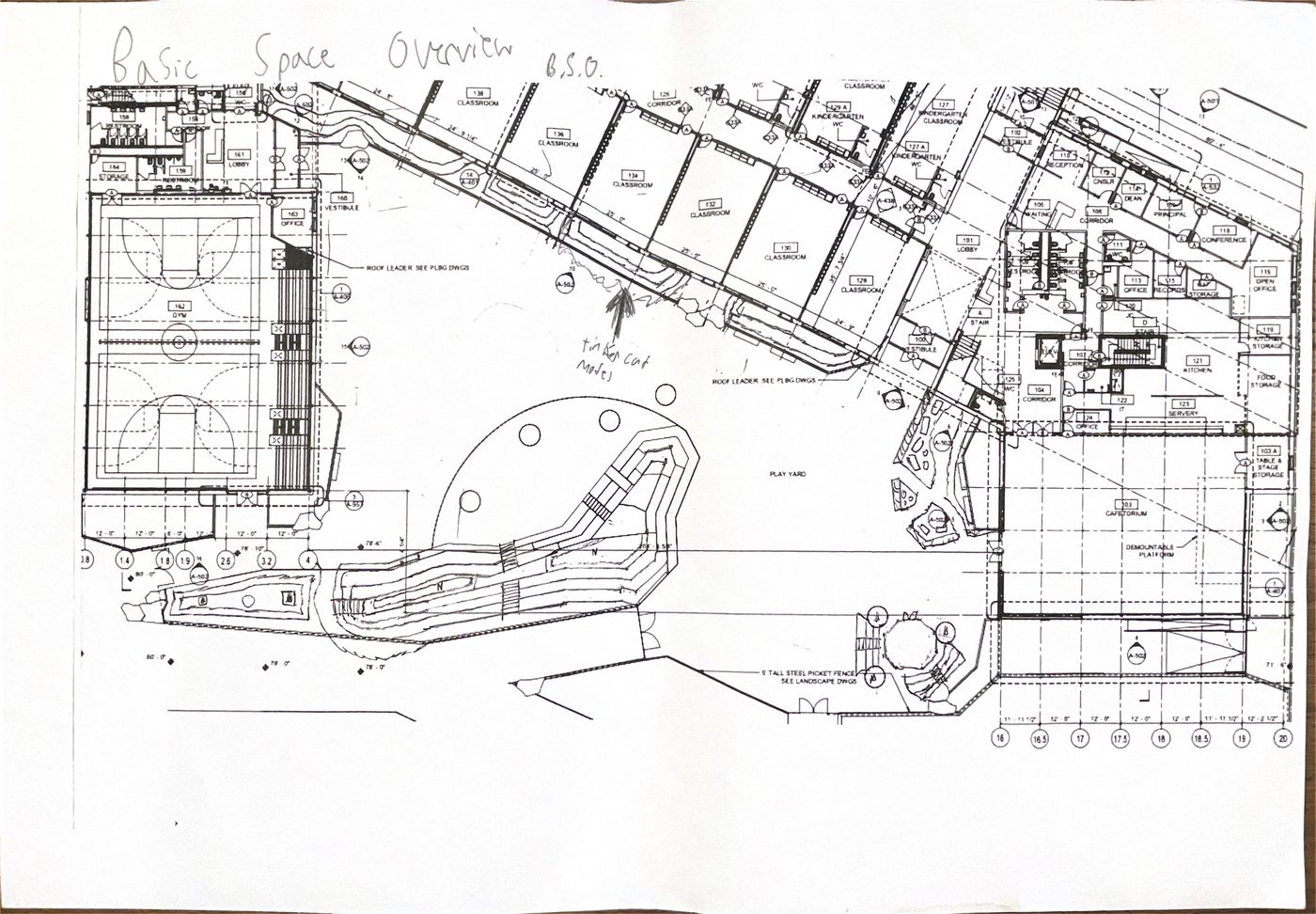
Basic Space Overview blueprint
B.S.O.
Basic Space Overview — the full footprint drawn on the actual school blueprint.
all diagrams →

Five Zones, One Continuous Space

Rather than assigning fixed seating or posting behavioral guidelines, the layout is designed so students naturally gravitate toward the zone that suits their activity level and social preference. Seating height, depth, orientation, and proximity to the yard do the work — no signage required.

Zone 01

Deep Dining

High-back, deeper seating configured for sustained use and face-to-face conversation. The primary eating zone, with table surfaces and shade sail coverage above.

Shade sail coverage directly overhead

Zone 02

Active Edge

Shallower, lower seating at the yard perimeter. Designed for students who eat quickly or want proximity to the active recess space without committing to a full sit-down.

Direct access to recess blacktop

Zone 03

Elevated Tier

Raised step seating that creates a natural amphitheater configuration. Suitable for larger group gatherings, watching yard activity, or informal socializing between periods.

Elevation change defines boundary without barriers

Zone 04

Quiet Corner

Visually screened from the active zones by planter landscaping. Lower ambient noise, greater privacy — designed to reduce overcrowding and provide a calmer environment.

Planter buffer provides soft visual separation

Zone 05

Circulation Path

Kept entirely clear of seating. Wide, ADA-compliant clearance routes allow students to move quickly and safely without cutting through an occupied seating area.

ADA-compliant clearance maintained throughout

Building the Model & Receiving Feedback

With the plan complete, the next phase was to construct a physical representation and subject it to peer evaluation. The feedback received then informed the final reflection.

Physical Scale Model — Develop Phase

Constructed using cardboard, craft sticks, and translucent plastic sheeting to represent the shade sail system. Layered cardboard tiers convey the elevation changes between zones. A parallel 3D digital model was also built using TinkerCAD.

My project partner, Evan, had absences during the primary design sessions. As a result, I drove the majority of the design decisions — a dynamic I reflected on honestly when the teacher asked about our collaboration process.

What I Learned & How It Was Assessed

What I Would Do Differently
  • Use higher-quality model materials — balsa wood or foam board instead of cardboard
  • Apply adhesives with more precision to produce a finish consistent with the design concept
  • Include a scaled floor plan reference to communicate spatial proportions more clearly
  • Find more structured methods for incorporating a partner's input when working through complex design decisions remotely
Where I Exceeded Requirements
  • Set a personal capacity target of 700 students — the assignment required a minimum of 45
  • Used only 8% of the blacktop — the assignment permitted up to 50%
  • Added five self-defined criteria beyond the brief: budget cap, minimum lifespan, social awareness, ADA access, and aesthetic compatibility
  • Every design decision is traceable to a specific finding from the research phase
"

Leo, I enjoy how your design showcases a simplistic nature. It is a completely different vibe from a lot of the other designs — very efficient in both structure and longevity. I appreciate how in depth you were engaged in the design process.

— Mr. Franklin & Ms. Graefeld, Written Assessment Feedback
95 / 100

Exceeds Expectations across all five rubric categories

The rubric assessed Design, Knowledge, Application, Process, and Presentation — all scored at the highest level. Mr. Franklin and Ms. Graefeld specifically noted the depth of research integration and the additional criteria I set independently beyond the requirements of the brief.

Design Knowledge Application Process Presentation